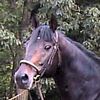
Please let me know what you think of Apocaliptic Star (already entered in PQ) pedigree and conformation wise.
Thanks


Moderators: Roguelet, hpkingjr, WaveMaster
Archer wrote:I don't think this is a bad picture, but rather an excellent view of back-at-the-knee, a serious conformation fault. If you want the critique to continue, I'd say she's also straight thru the shoulder (as well as a bad hind leg - too straight, not enough angle) and she appears to have short upright pasterns, a thin short neck and maybe a bit high-headed, and I would have liked to have seen a bit more length given how leggy she is. I discounted her being high behind and gave her the benefit of the doubt that she's just going through a growing stage. OK, so what does all of this mean?
Back at the knee:
http://www.equisearch.com/horses_care/health/anatomy/conformationfaults110299a/
I guess what you should know is that there have been good racehorses who were back-at-the-knee - "good racehorse" doesn't mean "perfect racehorse conformation." But, that said, horses who are back-at-the-knee are more disposed to certain injuries. Personally, I've had more tendon problems than knee injuries with back-at-the-knee, but suffice to say, this conformation (back-at-the-knee PLUS short upright pasterns and being generally straight up-and-down) predisposes one to unsoundness, particularly thru the knees. She's just not designed to take the concussion of racing.

madelyn wrote:I just looked up her pedigree, and she looks VERY much like her sire, who was unraced. Not a good sign.
madelyn wrote:I just looked up her pedigree, and she looks VERY much like her sire, who was unraced. Not a good sign.
jellac wrote:Please remember that while there may be pretty good agreement among those who race/breed to race thoroughbreds as to what is most desirable in conformation correctness nothing is in 'black and white' with respect to the correlation between conformational correctness and racing ability. In other words conformational correctness often has little relationship to whether or not a horse can survive race training/conditioning to make it to the races, let alone at what level it can race. It's a horse race not a beauty pageant, after all and thoroughbred history is replete with ill-conformed or at least not perfectly conformed individuals that outran all their faults and the perfect points of their competition. HOWEVER, the degree of deviation from a conformational ideal and the nature of that deviation can and usually will have some relationship to how long their career lasts, i.e. durability and what sorts of 'issues' that individual may be expected to have to deal with. To some extent recognition of this aspect of a conformational deviation from the 'ideal' can allow the owner/trainer to develop a training schedule/program that 'works with' not against the individual's so-called flaws to assure a longer career and a better racing level. This is whay some traits considered an absolute 'no-no' by one buyer/trainer will be something of not much concern, or perhaps even a plus, by another.
I would definitely consider this filly to exhibit 'back at the knee' conformation BUT she is only 15 months old in the photo and is not severely back at the knee. She is - as Madelyn points out - a dead ringer for her sire and it gives me some concern that he too did not race, but you have an explanation for that which has nothing to do with his front-end plus the apparent success of his first offspring to race to argue against getting overly worked up over this trait as a 'flaw' that makes her purchase a "$10K mistake".
There are also several unraced dams in her tail female damline and that frankly concerns me more than whether or not her sire raced given he is now proven capable of producing runners/winners, albeit from small crops.
As others have noted this filly is leggy and high rumped but all growing thoroughbreds go through this stage and eventually her front end/withers will catch up with that rump and she should develop a mature topline that, hopefully is more level, bringing her front end into better balance with her hindend. By all means wait for this to occurr before you begin race conditioning her. You may go forward with the usual backing/initial training most TBs undergo as late yearlings/early 2YOs but with this individual I personally would hold off before continuing with the galloping and then speed work, that prepares a horse for actual racing. Having her 'engine' angling down into her forequarters will cause her to hit the ground more stiffly or more hard when you begin to gallop her in preparation for racing than she might do when balanced out in her growth. Since, as has been mentioned, she may have a bit of a front end issue I'd not do anything to aggravate it and early speed work with this horse before she's re-balanced her frame will do that. Hold off on that stage until you are satisfied she has done all the leveling out she is going to do. This does not mean she shouldn't be backed and given basic instruction on how to behave under saddle, etc. When you do have her 'backed', i..e mounted and taught how to turn right or left from the rider's aids I would recommend you have someone who is trained in dressage work with her initially to teach her how to balance herself in a collected manner and how to use her hindquarters underneath her for maximun propulsion/elasticity at the gaits/lightness on the bit/in the bridle. It can only help her when she is ready for the speed work which is largely done fully extended rather than collected. From such a foundation she will have at least learned better how to use herself while developing the musculature to help her move in a more balanced, light on the front end manner. As Larrygene pointed out the other "flaws" that are spoken of speak to him more of a 'speed' type horse and I would also tend to agree with that. Since all TBs start their speed work at short distances and most make their initial starts at short distances this will give you a chance to see early on her training if this 'speed bias' of her conformation exists. If so I might also suggest that when it is time for her to make her initial out that she start at sprint distances on the turf to further cushion her frontend as she is tested in racing company. Mind you don't be too rigorous about all this advice as it is all a matter of speculation - she may very well have a built in genetic preference for the dirt and if so, then that's where you need to take her to see the most that she can do. I'm just suggesting you consider starting her out on the 'kindest' and most natural of surafaces as she learns how to handle herself under true racing conditions. If/when you do put her on dirt be choosey about which dirt tracks you take her to - some are very fast and very hard while some are certainly more forgiving. As to the upright pastern comment I tend to agree but I have recetnly read an observation on pastern allignment from a longtime farrier that stated where horses were pastured/raised comes into play. Those raised/pastured on soft, mushy ground (the South in general, SE Texas and parts of Florida) will tend to have 'let down' or angled pasterns, then when moved to an areas with harder/firmer substrate (Ky's limestone, California's stoney sands, etc.) they will tend to become more vertical or 'straighten up' (or was it the other way around?) In any event I was intrigued by the idea that perhaps to some degree pastern allignment is a function of the surface the horse is regularly exposed to. Any comments by others on this board about that? I'd like to hear them. Bottomline is I wouldn't try to do any 'corrective' shoeing or trimming to get the so-called ideal angle - better that she have very nice, well formed hooves to do h er running on.