Leads?
Moderators: Roguelet, hpkingjr, WaveMaster
There was a study done back in the 70's I believe (somebody got funding to go watch the races every day, pretty sweet deal) where the guy studied the number of lead changes horses make during a race. He concluded that there was no definite pattern that it was entirely up to the horse. One horse he documented made no lead changes during an entire 8f race. Other made many many lead changes.
My experience at the track in recent years however is that these types of horses would be rejected by trainers and jockeys as having something wrong with them. Trainers and jockeys now days want the horses to change leads like machines, at specific points on the track. Any horse that does not conform is treated as defective. My personal view is that horses know more about changing leads than any human, if they want to compete they will change leads to their fresher legs if the rider is providing the appropriate encouragement.
My experience at the track in recent years however is that these types of horses would be rejected by trainers and jockeys as having something wrong with them. Trainers and jockeys now days want the horses to change leads like machines, at specific points on the track. Any horse that does not conform is treated as defective. My personal view is that horses know more about changing leads than any human, if they want to compete they will change leads to their fresher legs if the rider is providing the appropriate encouragement.
-
Shammy Davis
- Chef de Race: Classic
- Posts: 4451
- Joined: Sat Oct 02, 2004 8:23 am
-
Barn 31 T-breds

- 2yo Maiden
- Posts: 96
- Joined: Fri Nov 16, 2007 6:35 pm
- Location: NJ
First, lets set up the scenario.
I would assume you are talking about 6f, around one turn, counter clockwise, which is the majority of races run in the US on tracks at least one mile in circumference.
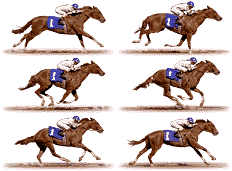
Ideally, you would want the horse to start out on his right lead, stay on it for about 1/4 mile, then switch to the left lead before the turn. You would want him to stay on the left lead until straightening out in the stretch, then switch back to the right for the remainder of the race.
Horses that refuse to switch leads very often have a physical problem that prevents them from doing so. It is a red flag and one that I always take into account when looking for a horse to claim.
Horses that do not change leads almost always tire in the stretch. Watch 100 races and see how many horses maintain their speed to the wire without changing leads. There are very, very few. It becomes especially poignant when two horses are head to head at the eighth pole and one has changed leads and the other hasn't. I will put my money on the horse that changed leads every single time.
Mark Twain is credited with the saying "there are three kinds of lies: lies, damned lies, and statistics."
Any study that examines lead changes would have to take into account race distances, number of turns in the race, size of track and length of stretch. Naturally, horses going around two turns at a mile or better are going to change leads more often than horses going one turn at 5f.
Comparing apples to oranges just doesn't yield fruit (excuse the pun)
I would assume you are talking about 6f, around one turn, counter clockwise, which is the majority of races run in the US on tracks at least one mile in circumference.
Ideally, you would want the horse to start out on his right lead, stay on it for about 1/4 mile, then switch to the left lead before the turn. You would want him to stay on the left lead until straightening out in the stretch, then switch back to the right for the remainder of the race.
Horses that refuse to switch leads very often have a physical problem that prevents them from doing so. It is a red flag and one that I always take into account when looking for a horse to claim.
Horses that do not change leads almost always tire in the stretch. Watch 100 races and see how many horses maintain their speed to the wire without changing leads. There are very, very few. It becomes especially poignant when two horses are head to head at the eighth pole and one has changed leads and the other hasn't. I will put my money on the horse that changed leads every single time.
Mark Twain is credited with the saying "there are three kinds of lies: lies, damned lies, and statistics."
Any study that examines lead changes would have to take into account race distances, number of turns in the race, size of track and length of stretch. Naturally, horses going around two turns at a mile or better are going to change leads more often than horses going one turn at 5f.
Comparing apples to oranges just doesn't yield fruit (excuse the pun)

-
wangkw

- Restricted Stakes Winner
- Posts: 969
- Joined: Mon Jan 07, 2008 5:48 am
- Location: Singapore -- Small, Solid Island In Dictatorship
bdw0617 wrote:i have no idea how to spot when a horse changes leads alhtough I do know what a horse looks like when he is "on his wrong lead" in the stretch.
Very fresh and interesting topic..you guys are good.
Last edited by wangkw on Mon Jun 08, 2009 2:41 pm, edited 1 time in total.
Our Greatest Glory Is Not In Never Falling But In Rising Everytime We Fall
It's certainly true that a horse has a particular style that may involve a different frequency of lead changes, but switching leads back and forth in the stretch is often a sign of injury. Jocks will often not ride a horse back that does that.
"When I am on my deathbed, I imagine I will say, 'Thank God I did that'" - Arthur Hancock, on buying back Gato del Sol from Europe after Exceller was killed in a slaughterhouse in Sweden.
Barn 31 T-breds wrote:First, lets set up the scenario.
I would assume you are talking about 6f, around one turn, counter clockwise, which is the majority of races run in the US on tracks at least one mile in circumference.
Ideally, you would want the horse to start out on his right lead, stay on it for about 1/4 mile, then switch to the left lead before the turn. You would want him to stay on the left lead until straightening out in the stretch, then switch back to the right for the remainder of the race.
Horses that refuse to switch leads very often have a physical problem that prevents them from doing so. It is a red flag and one that I always take into account when looking for a horse to claim.
Horses that do not change leads almost always tire in the stretch. Watch 100 races and see how many horses maintain their speed to the wire without changing leads. There are very, very few. It becomes especially poignant when two horses are head to head at the eighth pole and one has changed leads and the other hasn't. I will put my money on the horse that changed leads every single time.
Mark Twain is credited with the saying "there are three kinds of lies: lies, damned lies, and statistics."
Any study that examines lead changes would have to take into account race distances, number of turns in the race, size of track and length of stretch. Naturally, horses going around two turns at a mile or better are going to change leads more often than horses going one turn at 5f.
Comparing apples to oranges just doesn't yield fruit (excuse the pun)
what he said.

-
Vindicated
- Allowance Winner
- Posts: 342
- Joined: Tue Nov 09, 2004 7:46 am
The trainers on this site may find fault with this, however.
I have been riding hunters & jumpers for 22 years with several years spent on ex-racehorses or hopefully-going-to-be-racehorses. A horse must be balanced to do a lead change & unbalanced rider weight will interfere with this.
A smart horse will change leads if they are physically able-but even a jock can throw a horse off balance enough to make it impossible to switch leads.
Simple schooling can teach a horse to switch leads effectively, while most (all) horses I get off the track now a days switch incorrectly-with loss of momentum.
I would not discount a horse that does not switch leads until looking into all possible causes of that horse not swapping.
I have been riding hunters & jumpers for 22 years with several years spent on ex-racehorses or hopefully-going-to-be-racehorses. A horse must be balanced to do a lead change & unbalanced rider weight will interfere with this.
A smart horse will change leads if they are physically able-but even a jock can throw a horse off balance enough to make it impossible to switch leads.
Simple schooling can teach a horse to switch leads effectively, while most (all) horses I get off the track now a days switch incorrectly-with loss of momentum.
I would not discount a horse that does not switch leads until looking into all possible causes of that horse not swapping.
-
wangkw
- Restricted Stakes Winner
- Posts: 969
- Joined: Mon Jan 07, 2008 5:48 am
- Location: Singapore -- Small, Solid Island In Dictatorship
[quote="Barn 31 T-breds"]
.......................................................
Any study that examines lead changes would have to take into account race distances, number of turns in the race, size of track and length of stretch.
Naturally, horses going around two turns at a mile or better are going to change leads more often than horses going one turn at 5f.
Comparing apples to oranges just doesn't yield fruit (excuse the pun)[/quote]
......................................................
But...excusez moi..how the hell horses know what distance they are racing in ? Or how many turns there are ahead for them ?
Unless you are saying they can sense how much 5f is and just change leads at that point of the distance or when they are
making a turn (by the signal from their jockey ).
I doubt jocks will yell to their mounts : hello, pal, changes your lead, now 5f.
.......................................................
Any study that examines lead changes would have to take into account race distances, number of turns in the race, size of track and length of stretch.
Naturally, horses going around two turns at a mile or better are going to change leads more often than horses going one turn at 5f.
Comparing apples to oranges just doesn't yield fruit (excuse the pun)[/quote]
......................................................
But...excusez moi..how the hell horses know what distance they are racing in ? Or how many turns there are ahead for them ?
Unless you are saying they can sense how much 5f is and just change leads at that point of the distance or when they are
making a turn (by the signal from their jockey ).
I doubt jocks will yell to their mounts : hello, pal, changes your lead, now 5f.
Our Greatest Glory Is Not In Never Falling But In Rising Everytime We Fall
-
Barn 31 T-breds
- 2yo Maiden
- Posts: 96
- Joined: Fri Nov 16, 2007 6:35 pm
- Location: NJ
Ok, wang.
It's obvious by your post that you know very little about horses, racing, and their training.
If you had taken the time to read my original post, you could answer some of your own questions.
On a mile track, a horse racing a mile or more would go around two turns. He would start out on his right lead, switch to his left going into the first turn, switch back to his right down the back stretch, switch to his left going around the far turn, then switch to his right down the stretch.
That's four lead changes.
The same horse would change leads twice in a 6f race.
Got it?
Horses don't need to "know" what the distance of their race is. They know when to change leads the same way they "know" when to accelerate, move left, move right, etc.
Their jockey tells them. And of course not with verbal commands (except riders will chirp to their mounts when they want more speed).
Just as jockeys will steer them with the reins, or urge them with their whips, jocks will shift their weight to give the horse a cue when to change leads.
Race horses are gotten ready to race by their trainers and are commanded in the race by their jockeys.
There is no decision making on their parts.
It's obvious by your post that you know very little about horses, racing, and their training.
If you had taken the time to read my original post, you could answer some of your own questions.
On a mile track, a horse racing a mile or more would go around two turns. He would start out on his right lead, switch to his left going into the first turn, switch back to his right down the back stretch, switch to his left going around the far turn, then switch to his right down the stretch.
That's four lead changes.
The same horse would change leads twice in a 6f race.
Got it?
Horses don't need to "know" what the distance of their race is. They know when to change leads the same way they "know" when to accelerate, move left, move right, etc.
Their jockey tells them. And of course not with verbal commands (except riders will chirp to their mounts when they want more speed).
Just as jockeys will steer them with the reins, or urge them with their whips, jocks will shift their weight to give the horse a cue when to change leads.
Race horses are gotten ready to race by their trainers and are commanded in the race by their jockeys.
There is no decision making on their parts.
-
wangkw
- Restricted Stakes Winner
- Posts: 969
- Joined: Mon Jan 07, 2008 5:48 am
- Location: Singapore -- Small, Solid Island In Dictatorship
Thanks...ok..signal come from the josks...when turning..ok..horses can sense..on the straight..what kinda gesture horses need to sense
its time to change leads..just curious.
Must say this very first time I come across this term LEADS..tks the threadmaster too.
I am outsider per se...you are spot on.
its time to change leads..just curious.
Must say this very first time I come across this term LEADS..tks the threadmaster too.
I am outsider per se...you are spot on.
Our Greatest Glory Is Not In Never Falling But In Rising Everytime We Fall
wangkw wrote:what kinda gesture horses need to sense
its time to change leads..just curious.
wangkw
Horses have various cadences at different gaits. The easiest to understand is the walk, a four beat gait. The footfall pattern is right rear right front, left rear, left front. The trot is a two beat gait, with the front leg on one side in sync with the diagonal (or opposite) rear leg. A skilled rider will learn to recognize the footfalls and can tell when each leg hits the ground at each gait. The canter is a three-beat gait, meaning that there are three footfalls heard per stride. Each footfall is the "grounding" phase of a leg. The three footfalls are evenly spaced, and followed by the "suspension" phase of the gait, which is when all four legs are off the ground. The three beats and suspension are considered one stride. The movement for one stride is as follows:
Beat One: the grounding phase of the outside hind leg. There are many riders who think a front leg is the first beat of the canter, which is incorrect. At this time, the other three legs are off the ground.
Beat Two: the simultaneous grounding phase of the inside hind leg and outside fore leg. The inside fore leg is still off the ground. The outside hind leg (beat one), is still touching the ground, but is about to be lifted off.
Beat Three: The grounding phase of the inside foreleg. The outside hind leg (beat one), is off the ground. The inside hind leg and outside foreleg are still touching the ground, but are about to be lifted up.
The inside hindleg and outside foreleg (beat two) are lifted off the ground. The inside foreleg is the only foot supporting the horse's weight.
The inside foreleg is lifted off the ground.
Suspension: The horse has all four legs off the ground.
The faster the horse is moving, the longer is the time of the phase of suspension relative to the time of the three beats.
A lead change has been defined by Jack Brainard, a master of the western lead change, as a change in the phase sequence where the hind legs interchange their roles resulting an overall change in the footfall pattern. This also results in a change in the balance of the horse and a change in the bend of the horse. When a horse is on the right lead the body travels in a slight right hand arc. When on the left lead the arc is to the left. Skilled riders can easily recognize the lead of the horse at the canter and can cue the horse to change leads by 1. changing the arc of the horse by moving its hip or 2. by changing the balance of the horse(This is the most common technique in racing). A well trained horse learns to recognize the riders cues and changes leads when asked. These cues are most appropriately applied during the suspension phase of the gait.
A gallop is an extended canter where the diagonal pair is no longer in sync. However, the principles of the leads and lead changes remain the same.
Hope this helps
Chuck
-
wangkw
- Restricted Stakes Winner
- Posts: 969
- Joined: Mon Jan 07, 2008 5:48 am
- Location: Singapore -- Small, Solid Island In Dictatorship
Hi cewright
Tks for info I just came back from outside..will spend a bit of time going through..and try understand if able.
You guys are good really..
Tks to Barn 31 too..I was 3/4 joking to make life easier and please find no offence in it..Wilf used to be annoyed too
as he initially tought I was naughty with language and words..seems he has accepted me now.
Cheers...from those equestrian shows..horses are highly sensible animals..no doubt about it..I love these
fellows..thats why I spend time in it..lot of time..ala..I am supposed to be closer to share market.
Tks for info I just came back from outside..will spend a bit of time going through..and try understand if able.
You guys are good really..
Tks to Barn 31 too..I was 3/4 joking to make life easier and please find no offence in it..Wilf used to be annoyed too
as he initially tought I was naughty with language and words..seems he has accepted me now.
Cheers...from those equestrian shows..horses are highly sensible animals..no doubt about it..I love these
fellows..thats why I spend time in it..lot of time..ala..I am supposed to be closer to share market.
Our Greatest Glory Is Not In Never Falling But In Rising Everytime We Fall