Madelyn:
I find your interpretation interesting because it is exactly opposite of what I see. I see the relatively short steep humerous in the shoulder as allowing a great range of motion creating a potentially very long stride with relatively low stride frequency. I see the lightly developed gaskin as supporting my view that the horse used a long, low frequency stride. This is why I asked if anyone had seen him run and could comment on what his stride was like.
Critique this Horse
Moderators: Roguelet, WaveMaster, madelyn
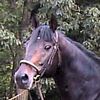
What you see on this horse is a sort of "Saddlebred" shoulder... the Saddlebred folk breed for the shoulder because it usually results in a horse able to hit his eyeballs with his knees. Skip Away has it, and passes it on.. resulting in very high action in his offspring (I know, I have one).. fortunately some of them have enough other assets to offset the action. When it is packaged with good bone and compact build, as in this stallion, it can result in a horse who may not have a long stride, but may be able to achieve more strides per second. Conformation is a VERY subjective topic, and one man's idea of "perfection" may be another's "extremely flawed." And for the naked eye, the person judging the horse can only attempt to visualize the entire skeleton under all the skin and flesh to try to predict how that conformation will perform.
If you look at this diagram
http://www.sagehillcmk.com/Equine%20Skeleton.html
the bone you refer to as "humerous".. well in a straight shoulder where the scapula is more vertical, the resulting angle would put the humerus nearly parallel to the ground and the angle of the scapula would restrict forward motion. That is why that kind of shoulder is considered a serious conformation flaw for jumpers. The horse just can't get his forelegs forward enough.
If you look at this diagram
http://www.sagehillcmk.com/Equine%20Skeleton.html
the bone you refer to as "humerous".. well in a straight shoulder where the scapula is more vertical, the resulting angle would put the humerus nearly parallel to the ground and the angle of the scapula would restrict forward motion. That is why that kind of shoulder is considered a serious conformation flaw for jumpers. The horse just can't get his forelegs forward enough.
So Run for the Roses, as fast as you can.....
[quote :
I would say it was long enough to set a new world record that was almost a second faster than Dr. Fager's record on dirt. You are right about the gaskin, I have seen a lot more runners without it than with it. I just prefer a heavier muscled horse.[/quote]
I second casallc response. Having looked at this horse's conformation without knowing his identity shows that conformation is at best relative.
This horse has the kind of leg conformation that can carry its body, and that's part of when we speak of 'balanced.' Besides, you almost never know how a horse moves just looking at its conformation. We set ideals of which nature knows nothing for the most part. Take Secretariat as an example. The opinions about his conformation were not unanemous; some people said he was goose-rumped and too straight through the hocks; he had too much neck as a young stallion, etc. He most definitely didn't have the best of shoulder angles. He did have a large heart and whatever else it takes to make such a great race horse. Compare Secretawriat with Man O'War, and you can see that conformation is an individual thing at best.
SB
I would say it was long enough to set a new world record that was almost a second faster than Dr. Fager's record on dirt. You are right about the gaskin, I have seen a lot more runners without it than with it. I just prefer a heavier muscled horse.[/quote]
I second casallc response. Having looked at this horse's conformation without knowing his identity shows that conformation is at best relative.
This horse has the kind of leg conformation that can carry its body, and that's part of when we speak of 'balanced.' Besides, you almost never know how a horse moves just looking at its conformation. We set ideals of which nature knows nothing for the most part. Take Secretariat as an example. The opinions about his conformation were not unanemous; some people said he was goose-rumped and too straight through the hocks; he had too much neck as a young stallion, etc. He most definitely didn't have the best of shoulder angles. He did have a large heart and whatever else it takes to make such a great race horse. Compare Secretawriat with Man O'War, and you can see that conformation is an individual thing at best.
SB

Madelyn:
I don't think we disagree on what is desirable, I think we're just seeing different qualities in the subject horse. IMO the slope of the scapula is independent of the shoulder joint angle so that a horse like Mr. Light can have a steep slope to his scapula but still have an open shoulder angle allowing him to bring his legs forward. IMO the steep scapula slope will cause a lower head carriage which I feel can contribute to a tendency to choke but that's JMO, no science to back that up. In the photo in the original post it is a little bit difficult to see exactly where his elbow is and since you need to see where the elbow is to determine the angle of the shoulder joint, maybe one or both of us would have a different opinion of the horse seeing him in person.
Personally, I do not think of conformational variations in the shoulder so much as flaws, I think of them more in terms of suitability for a particular task. Many of the qualities I consider highly desirable in a racehorse I would consider undesirable in a cutting horse, and vice versa.
I don't think we disagree on what is desirable, I think we're just seeing different qualities in the subject horse. IMO the slope of the scapula is independent of the shoulder joint angle so that a horse like Mr. Light can have a steep slope to his scapula but still have an open shoulder angle allowing him to bring his legs forward. IMO the steep scapula slope will cause a lower head carriage which I feel can contribute to a tendency to choke but that's JMO, no science to back that up. In the photo in the original post it is a little bit difficult to see exactly where his elbow is and since you need to see where the elbow is to determine the angle of the shoulder joint, maybe one or both of us would have a different opinion of the horse seeing him in person.
Personally, I do not think of conformational variations in the shoulder so much as flaws, I think of them more in terms of suitability for a particular task. Many of the qualities I consider highly desirable in a racehorse I would consider undesirable in a cutting horse, and vice versa.
Watch the stride for your self. I just don't see the short stride.
http://www.millridge.com/media/videos/g ... 205-r8.wmv
He does run with his head a little higher that the others, but his stride is fine.
http://www.millridge.com/media/videos/g ... 205-r8.wmv
He does run with his head a little higher that the others, but his stride is fine.

cool video!
That was a fun race to watch. Coincidentally, we haev Freefourinternet on our list of stallions - not too impressive in that race and the announcer alluded to him being a stretch runner (he was 10 lengths behind for most of the race)... I'll have to look at more of his races! Mr. Light was pretty exciting to watch!