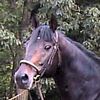
The ears are photos of the same horse, a appy with TB on the bottom line. I've never seen ears like this before, the were twisted like a corkscrew. Looked like someone grabbed the tip and twisted the whole thing to the outside. The photos pretty much failed to capture this look. I also couldn't get the horse to prick his ears up. Very laid back fellow.
No need to return the pictures.
Ears
Moderators: Roguelet, hpkingjr, WaveMaster, Lucy

I apologize for being somewhat MIA lately and not responding here before now. Georgerz is correct, Indy Mood was bandage bowed before he ever raced. He still stands here in Indiana.
As for the ears and the connection to the large heart; I have been told that Indy Mood's daughters should be very good broodmare prospects, due in part to the large heart gene being passed down via his X chromasome... following this logic, should his daughters then possess the ear curl, and in turn, their offspring?
I'm sure there are other Indy Mood grandfoals out there, but we got our own first foal out of an Indy Mood daughter this year (a colt) and I admit to not having paid much attention to his ear shape... but now I will have to check it out.
As for the ears and the connection to the large heart; I have been told that Indy Mood's daughters should be very good broodmare prospects, due in part to the large heart gene being passed down via his X chromasome... following this logic, should his daughters then possess the ear curl, and in turn, their offspring?
I'm sure there are other Indy Mood grandfoals out there, but we got our own first foal out of an Indy Mood daughter this year (a colt) and I admit to not having paid much attention to his ear shape... but now I will have to check it out.
**************************************

"Don't be a boorish buffoon" -Hokies Respect 'Jerk Alert'
"Don't be a boorish buffoon" -Hokies Respect 'Jerk Alert'
Roguelet wrote:As for the ears and the connection to the large heart; I have been told that Indy Mood's daughters should be very good broodmare prospects, due in part to the large heart gene being passed down via his X chromasome... following this logic, should his daughters then possess the ear curl, and in turn, their offspring?
I'm sure there are other Indy Mood grandfoals out there, but we got our own first foal out of an Indy Mood daughter this year (a colt) and I admit to not having paid much attention to his ear shape... but now I will have to check it out.
According to the theory, a mare will have ears that are linked to the heart gene she's expressing. For example, Marianna Haun's double-copy mare, The Last Red, has the curly Princequillo ears (as noticed by Penny Chenery) because she's expressing the Princequillo gene she received from Moscow Ballet, but she also carries the heart gene found in Man o' War, which is why her colt by Alysheba has ears that look like Man o' War's ears.
-
xfactor fan
- Breeder's Cup Winner
- Posts: 2212
- Joined: Thu Sep 16, 2004 8:46 pm
-
Shammy Davis
- Chef de Race: Classic
- Posts: 4451
- Joined: Sat Oct 02, 2004 8:23 am
First, I thought the significant aspect was small ears not curly ears.
Second, did you know that Malibu Moon is out of the 2-s family through Bankrupt.
I wish the Xfactor Book had more information on the ears. I'm still a little confused but I am a person who really has to re-read and re-read to get all the pertinent points.
In the book, I'm somewhat confused by the pedigrees that show the Xfactor related only to the dam side. I think it is because I'm assuming that sire's side also carries the large heart.
Second, did you know that Malibu Moon is out of the 2-s family through Bankrupt.
I wish the Xfactor Book had more information on the ears. I'm still a little confused but I am a person who really has to re-read and re-read to get all the pertinent points.
In the book, I'm somewhat confused by the pedigrees that show the Xfactor related only to the dam side. I think it is because I'm assuming that sire's side also carries the large heart.
-
xfactor fan
- Breeder's Cup Winner
- Posts: 2212
- Joined: Thu Sep 16, 2004 8:46 pm
Shammy,
Haun is a very bad science writer.
Sort of a recap which may help.
Stallions are YX. They only have one X, so whatever the have is expressed.
Mares are XX, but since they only need one X to be functional the other is banished to X limbo.
Daughters will get their sire's X, and about half will show it. The other half will show one of Mama's X's. So for the girls, there are three potential X's to look for. You know that a filly will have Daddy's X. You know Mama will have her Daddy's X. The third X is a wild card from somewhere deeper down the female side of the pedigree.
Colts get one or the other of Mama's X. So there are only two X's to look for, and the colts will show which X they have--much easier to figure than the girls.
The book goes on and on in a confusing manner about this issue. But if you keep this pattern of transmission in mind when you read the chapters, it should be clearer.
Haun is a very bad science writer.
Sort of a recap which may help.
Stallions are YX. They only have one X, so whatever the have is expressed.
Mares are XX, but since they only need one X to be functional the other is banished to X limbo.
Daughters will get their sire's X, and about half will show it. The other half will show one of Mama's X's. So for the girls, there are three potential X's to look for. You know that a filly will have Daddy's X. You know Mama will have her Daddy's X. The third X is a wild card from somewhere deeper down the female side of the pedigree.
Colts get one or the other of Mama's X. So there are only two X's to look for, and the colts will show which X they have--much easier to figure than the girls.
The book goes on and on in a confusing manner about this issue. But if you keep this pattern of transmission in mind when you read the chapters, it should be clearer.
-
Pan Zareta

- Breeder's Cup Winner
- Posts: 2074
- Joined: Wed Dec 22, 2004 10:55 am
- Location: west TX boonies
xfactor fan wrote:Daughters will get their sire's X, and about half will show it. The other half will show one of Mama's X's.
Generally (and grossly oversimplified), in any female mammal about half of all cells will express the maternal X and half the paternal X (otherwise, there would be more hemophiliac and color-blind human females). However, there is evidence (at least in a small but statistically significant % of humans) for non-random X inactivation, which in some cases may itself be a heritable trait.
So for the girls, there are three potential X's to look for. You know that a filly will have Daddy's X. You know Mama will have her Daddy's X. The third X is a wild card from somewhere deeper down the female side of the pedigree.
There is no third X. Since the female has two X chromosomes they recombine during gametogenesis. So the X chromosome rec'd. from the dam is always a combination of her maternal and paternal X chromosomes. Otoh, since there is no X chromosome recombination in the male, the paternal X chromosome is essentially a 'carbon copy' of the sire's.
In re. the ears, I thought Haun detected a casual association between heart size and ear shape, not a definitive linkage -

-
xfactor fan
- Breeder's Cup Winner
- Posts: 2212
- Joined: Thu Sep 16, 2004 8:46 pm
Let me rephrase the explanation. No normal mare has three X chromosomes. What I was trying to clarify was potential X candidates.
For a filly:
Mama has two X's. One is from her sire. Always there. One is from somewhere back in the pedigree.
Lets call these X1 : X2 Mare
Sire has one Y and one X. Let's call this one X3.
So a filly always gets X3 from her sire. But she could get either X1 from her dam, or X2 from her dam.
Potential combination's are: X3 X1, and X3 X2.
Hence three X chromosomes. Sorry if it sounded like we were discussing mutant horses.
Yep, I know that X inactivation is not nearly as random as it might be. But all the research I've seen is based on mouse X's. Didn't know there were human studies out there.
Have you read either of Haun's books? Absolutely terrible science writer. And what I was trying to do was give Shammy a simple explanation of the process that Haun takes several chapters to wander through. He's also starting with the second X Factor Book, which probably is making things more difficult. ( I'm not sure the woman ever gets the X chromosome inactivation process) She keeps referring to the inactive X as a recessive X.
Perhaps I should have started the post with "This is a very simple version of a very complicated subject"
For a filly:
Mama has two X's. One is from her sire. Always there. One is from somewhere back in the pedigree.
Lets call these X1 : X2 Mare
Sire has one Y and one X. Let's call this one X3.
So a filly always gets X3 from her sire. But she could get either X1 from her dam, or X2 from her dam.
Potential combination's are: X3 X1, and X3 X2.
Hence three X chromosomes. Sorry if it sounded like we were discussing mutant horses.
Yep, I know that X inactivation is not nearly as random as it might be. But all the research I've seen is based on mouse X's. Didn't know there were human studies out there.
Have you read either of Haun's books? Absolutely terrible science writer. And what I was trying to do was give Shammy a simple explanation of the process that Haun takes several chapters to wander through. He's also starting with the second X Factor Book, which probably is making things more difficult. ( I'm not sure the woman ever gets the X chromosome inactivation process) She keeps referring to the inactive X as a recessive X.
Perhaps I should have started the post with "This is a very simple version of a very complicated subject"
-
Shammy Davis
- Chef de Race: Classic
- Posts: 4451
- Joined: Sat Oct 02, 2004 8:23 am
Xfactor Fan replied:
You hit my problem right on the head. I'm old school and I'm so use to looking at pedigrees from how each side compliments the other. I'll keep the transmission in mind as I re-read some of the chapters. I read this book many years ago when it first came out. I didn't think much of it at first because it was so hard to follow then. I figure a couple more readings and I be able to discuss it. I've gotten my genetics text out too. I've google this subject and others. I am amazed at the number of studies on bovines and how few on equines.
I did save a farmer up the road a few thousand $ the other day. He was going to get rid of a very successful bull because the number of this bull's progeny were increasing in his breeding herd. "I don't want to get any three eyed calves." He told me.
He only had the main bull for a few years, so I encouraged him to work with the bull a few more years as he calves were large boned and healthy. I didn't think he would be disappointed.
He took my advice and in place of a new bull, he went out and bought himself a new $47K tractor.
I'm am totally lost in the logic of saving a few thousand on a new bull and going to $47K in debt.
. . . But if you keep this pattern of transmission in mind when you read the chapters, it should be clearer.
You hit my problem right on the head. I'm old school and I'm so use to looking at pedigrees from how each side compliments the other. I'll keep the transmission in mind as I re-read some of the chapters. I read this book many years ago when it first came out. I didn't think much of it at first because it was so hard to follow then. I figure a couple more readings and I be able to discuss it. I've gotten my genetics text out too. I've google this subject and others. I am amazed at the number of studies on bovines and how few on equines.
I did save a farmer up the road a few thousand $ the other day. He was going to get rid of a very successful bull because the number of this bull's progeny were increasing in his breeding herd. "I don't want to get any three eyed calves." He told me.
He only had the main bull for a few years, so I encouraged him to work with the bull a few more years as he calves were large boned and healthy. I didn't think he would be disappointed.
He took my advice and in place of a new bull, he went out and bought himself a new $47K tractor.
I'm am totally lost in the logic of saving a few thousand on a new bull and going to $47K in debt.
Last edited by Shammy Davis on Sat Nov 21, 2009 11:41 am, edited 1 time in total.
-
vineyridge
- Grade III Winner
- Posts: 1195
- Joined: Fri Jan 28, 2005 9:41 am
So in the egg formation process that starts in utero, all of the eggs have some of the mare's XXs recombined? And the percentage of dam sire's X and the female X will be different in each egg, ranging from 100% one or the other to 50-50? Even though the dam herself will only express one of her Xs?
Have they any idea what factors control non-random inactivation? And is that trait heritable?
Have they any idea what factors control non-random inactivation? And is that trait heritable?
Last edited by vineyridge on Sat Nov 21, 2009 9:52 am, edited 1 time in total.
Thread Killer Extraordinaire
-
Pan Zareta
- Breeder's Cup Winner
- Posts: 2074
- Joined: Wed Dec 22, 2004 10:55 am
- Location: west TX boonies
xfactor fan wrote:So a filly always gets X3 from her sire. But she could get either X1 from her dam, or X2 from her dam.
No, that filly and any/all other produce of the dam receive any potential combination of X1 and X2. It's pretty unlikely that any two or more foals would share exactly the same recombined configuration of their dam's X chromosomes.
The interesting aspect of the sire's X is that it's passed along unchanged. The X is a huge chromosome containing 8-12% of all genes, depending on which species and study one consults. Therefore, a filly is slightly more closely 'related' to her sire's dam than to any other individuals in that generation of her pedigree.
Have you read either of Haun's books? Absolutely terrible science writer.
I own and have read her first book, which imho was written to appeal to a mass (i.e. not necessarily scientifically minded) audience.
I'm not sure the woman ever gets the X chromosome inactivation process) She keeps referring to the inactive X as a recessive X.
That would indeed be confusing. Assuming her postulate that the large heart is due to a simple sex-linked dominant gene is true, in a heterozygous filly the (non-LH)recessive X is inactive only in ~half her cells.
-
Shammy Davis
- Chef de Race: Classic
- Posts: 4451
- Joined: Sat Oct 02, 2004 8:23 am
Madelyn asked:
I can't get away with anything when Madelyn is proof reading. I left out the word "three". It should read "three eyed calves."
I know this sounds funny coming from me, but I actually "think" faster than I type. I'll go back and edit. My youngest daughter says that having a conversation with me is a challenge because I never finish a complete thought. I guess I'm just thoughtless.
Shammy - what is an "eyed" calf?
I can't get away with anything when Madelyn is proof reading. I left out the word "three". It should read "three eyed calves."
I know this sounds funny coming from me, but I actually "think" faster than I type. I'll go back and edit. My youngest daughter says that having a conversation with me is a challenge because I never finish a complete thought. I guess I'm just thoughtless.
-
Shammy Davis
- Chef de Race: Classic
- Posts: 4451
- Joined: Sat Oct 02, 2004 8:23 am
