When I'm buying I always look for durability in the family. I want to see some black type (I can't afford GrI's) but more importantly I like to see many starts, in the female pedigree, lots of wins and good earnings. I like to see many years of racing like 2 -5 or higher. It doesn't matter if I'm looking at a colt or a filly.
Of course I want to see stallions in the bottom pedigree that have produced some nice quality horses. Now I expect them to have produced GrI stars. If I'm looking at a filly it would be nice if there is (close up) some nice broodmare sires. Residual value you know.
I don't want a pure sprinter, I like distance horses, so I'm going to look for distance in the pedigree.
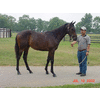
Then of course the yearling itself, I want good bone, nice shoulder, powerful hind end, solid bone, nice deep girth, nice pasterns etc. I can live with slightly off set knees, but no back at the knee, slight turn out is ok, but not turn in and other things.
The bottom of the pedigree is extremely important to me.
winds
What's most important to you on a catalog page?
Moderators: Roguelet, WaveMaster, madelyn
If it were me, knowing I couldn't afford to spend a lot it would be pedigree and a female family where the large heart were a possibility. It would also have to be a filly, in case she didn't have it I seek out a stud down the line who could have inherited it from his dam. Otherwise, it would be one who has Hoist the Flag on the dam side and Danzig on the sire side.
Of course it depends on the budget. I'd look at yearlings with a more fashionable pedigree if I had a large budget, but if my budget is small I don't want to see the offspring of high-priced stallions. You're better off buying the best Patton than the cheapest Storm Cat. That said, what I don't want to see on a catalog page:
1) room for notes at the bottom of the page
2) the sire and the broodmare sire with the same name
3) Pancho Villa or Bold Forbes anywhere on the page
4) no nomination to the Breeders Cup
5) no production from the first dam despite several quality attempts
You may be able to bend these "rules" slightly because it's still going to come down to the individual. It always comes back to the horse. Always.
1) room for notes at the bottom of the page
2) the sire and the broodmare sire with the same name
3) Pancho Villa or Bold Forbes anywhere on the page
4) no nomination to the Breeders Cup
5) no production from the first dam despite several quality attempts
You may be able to bend these "rules" slightly because it's still going to come down to the individual. It always comes back to the horse. Always.
-
Rokeby Forever
- Darley line
- Posts: 6684
- Joined: Thu Dec 21, 2006 4:52 pm
- Location: Reno, NV
Archer wrote:no production from the first dam despite several quality attempts
Let's suppose those "quality" attempts were just a bad nick, and on the dam's fifth or sixth mating, she's bred to a sire that nicks very well. What then?
When I see a mare's first foal is succesful and it's by a stallion completely differently bred from the stallion of the one that's in the ring, I get nervous. On the flip side, when I see her first few foals didn't pan out and her new foal is by a completely different sire, I get interested.
Nicks have been recorded since the 1700s...there has to be a reason.
What synthetics are to California racing:
http://www.youtube.com/watch?v=-gb0mxcpPOU
http://www.youtube.com/watch?v=-gb0mxcpPOU
-
Rokeby Forever
- Darley line
- Posts: 6684
- Joined: Thu Dec 21, 2006 4:52 pm
- Location: Reno, NV
I don't know what a nick is. I think it's something you get when you're shaving. But let's just say you believe that certain sires have an affinity for certain female families. I think those would be included in "quality" attempts.
What I was speaking of in particular, though, is a mare who has been bred to a variety of good stallions, produced marketable foals, and has yet to have her produce have racing success. I'm going to guess that she doesn't get runners. For instance, if she has failed with AP Indy, Distorted Humor, and Unbridled's Song and now the "nicking" suggests that she should have been bred to Lucky Lionel all along, I would pass. I'm going to hope they were right about Lionel but I wouldn't be betting on it (even though you're now getting a Lucky Lionel price).
Actually, I'd be inclined to pass on the produce of any mare who hasn't produced a stakes horse in her first four foals - no matter the nicks, no matter the stallion quality. On my list of things I wouldn't want to see on a catalog page would be a 15yo mare who has not produced a stakes horse. I don't care if she's produced a bunch of hard-knockin' solid types. No stakes horses yet - then she's unlikely to produce one.
Now, please don't list a bunch of mares who produced their first stakes horse when they were 16 years old. I know it happens. I'm just saying the likelihood decreases substantially, and if I was trying to buy a stakes horse, I would try to play the odds.
I would prefer to buy yearlings out of young mares with proven racing ability. That doesn't mean the mare has to have three G1's; I mean she should have shown some ability. I prefer racing ability over family. And I'm probably trying to buy one of those first four foals.
What I was speaking of in particular, though, is a mare who has been bred to a variety of good stallions, produced marketable foals, and has yet to have her produce have racing success. I'm going to guess that she doesn't get runners. For instance, if she has failed with AP Indy, Distorted Humor, and Unbridled's Song and now the "nicking" suggests that she should have been bred to Lucky Lionel all along, I would pass. I'm going to hope they were right about Lionel but I wouldn't be betting on it (even though you're now getting a Lucky Lionel price).
Actually, I'd be inclined to pass on the produce of any mare who hasn't produced a stakes horse in her first four foals - no matter the nicks, no matter the stallion quality. On my list of things I wouldn't want to see on a catalog page would be a 15yo mare who has not produced a stakes horse. I don't care if she's produced a bunch of hard-knockin' solid types. No stakes horses yet - then she's unlikely to produce one.
Now, please don't list a bunch of mares who produced their first stakes horse when they were 16 years old. I know it happens. I'm just saying the likelihood decreases substantially, and if I was trying to buy a stakes horse, I would try to play the odds.
I would prefer to buy yearlings out of young mares with proven racing ability. That doesn't mean the mare has to have three G1's; I mean she should have shown some ability. I prefer racing ability over family. And I'm probably trying to buy one of those first four foals.
-
Rokeby Forever
- Darley line
- Posts: 6684
- Joined: Thu Dec 21, 2006 4:52 pm
- Location: Reno, NV
White space at the bottom of a catalog page is a deal-killer for me also, even if it considerately leaves room for flight attendants' numbers for Rok's sake 
One thing I like is when really good proven sires are out-of-fashion, not all that commercial, or are just under the radar...that can help someone on a limited budget have access to very well-bred yearlings. Whoever it was that bought Funnycide got a great racehorse out of a (then) under-rated sire. For example, if a filly or colt out of Arch from a good dam family sells in my price range, and there was a Speightstown yearling selling for three times as much with a similar dam family, I would feel much more confident about the Arch yearling's prospects as a race horse, especially if I wanted a classic distance type prospect.
I consider nicks but don't necessarily get ruled by them...that being said, some nicks seem pretty emphatic. For example, Bold Ruckus mares crossed with Silver Deputy often equals stakes winners...as an example of one very successful pattern. So if I saw a quality Silver Deputy yearling out of an old, stakes-producing Bold Ruckus mare, I would find that kind of opportunity interesting even if the dam was fairly advanced in years, as Bold Ruckus mares are likely to be.
One thing I like is when really good proven sires are out-of-fashion, not all that commercial, or are just under the radar...that can help someone on a limited budget have access to very well-bred yearlings. Whoever it was that bought Funnycide got a great racehorse out of a (then) under-rated sire. For example, if a filly or colt out of Arch from a good dam family sells in my price range, and there was a Speightstown yearling selling for three times as much with a similar dam family, I would feel much more confident about the Arch yearling's prospects as a race horse, especially if I wanted a classic distance type prospect.
I consider nicks but don't necessarily get ruled by them...that being said, some nicks seem pretty emphatic. For example, Bold Ruckus mares crossed with Silver Deputy often equals stakes winners...as an example of one very successful pattern. So if I saw a quality Silver Deputy yearling out of an old, stakes-producing Bold Ruckus mare, I would find that kind of opportunity interesting even if the dam was fairly advanced in years, as Bold Ruckus mares are likely to be.
White space at the bottom of a catalog page is a deal-killer for me also, even if it considerately leaves room for flight attendants' numbers for Rok's sake
One thing I like is when really good proven sires are out-of-fashion, not all that commercial, or are just under the radar...that can help someone on a limited budget have access to very well-bred yearlings. Whoever it was that bought Funnycide got a great racehorse out of a (then) under-rated sire. For example, if a filly or colt out of Arch from a good dam family sells in my price range, and there was a Speightstown yearling selling for three times as much with a similar dam family, I would feel much more confident about the Arch yearling's prospects as a race horse, especially if I wanted a classic distance type prospect.
I consider nicks but don't necessarily get ruled by them...that being said, some nicks seem pretty emphatic. For example, Bold Ruckus mares crossed with Silver Deputy often equals stakes winners...as an example of one very successful pattern. So if I saw a quality Silver Deputy yearling out of an old, stakes-producing Bold Ruckus mare, I would find that kind of opportunity interesting even if the dam was fairly advanced in years, as Bold Ruckus mares are likely to be.
One thing I like is when really good proven sires are out-of-fashion, not all that commercial, or are just under the radar...that can help someone on a limited budget have access to very well-bred yearlings. Whoever it was that bought Funnycide got a great racehorse out of a (then) under-rated sire. For example, if a filly or colt out of Arch from a good dam family sells in my price range, and there was a Speightstown yearling selling for three times as much with a similar dam family, I would feel much more confident about the Arch yearling's prospects as a race horse, especially if I wanted a classic distance type prospect.
I consider nicks but don't necessarily get ruled by them...that being said, some nicks seem pretty emphatic. For example, Bold Ruckus mares crossed with Silver Deputy often equals stakes winners...as an example of one very successful pattern. So if I saw a quality Silver Deputy yearling out of an old, stakes-producing Bold Ruckus mare, I would find that kind of opportunity interesting even if the dam was fairly advanced in years, as Bold Ruckus mares are likely to be.
White space at the bottom of a catalog page is a deal-killer for me also, even if it considerately leaves room for flight attendants' numbers for Rok's sake
One thing I like is when really good proven sires are out-of-fashion, not all that commercial, or are just under the radar...that can help someone on a limited budget have access to very well-bred yearlings. Whoever it was that bought Funnycide got a great racehorse out of a (then) under-rated sire. For example, if a filly or colt out of Arch from a good dam family sells in my price range, and there was a Speightstown yearling selling for three times as much with a similar dam family, I would feel much more confident about the Arch yearling's prospects as a race horse, especially if I wanted a classic distance type prospect.
I consider nicks but don't necessarily get ruled by them...that being said, some nicks seem pretty emphatic. For example, Bold Ruckus mares crossed with Silver Deputy often equals stakes winners...as an example of one very successful pattern. So if I saw a quality Silver Deputy yearling out of an old, stakes-producing Bold Ruckus mare, I would find that kind of opportunity interesting even if the dam was fairly advanced in years, as Bold Ruckus mares are likely to be.
One thing I like is when really good proven sires are out-of-fashion, not all that commercial, or are just under the radar...that can help someone on a limited budget have access to very well-bred yearlings. Whoever it was that bought Funnycide got a great racehorse out of a (then) under-rated sire. For example, if a filly or colt out of Arch from a good dam family sells in my price range, and there was a Speightstown yearling selling for three times as much with a similar dam family, I would feel much more confident about the Arch yearling's prospects as a race horse, especially if I wanted a classic distance type prospect.
I consider nicks but don't necessarily get ruled by them...that being said, some nicks seem pretty emphatic. For example, Bold Ruckus mares crossed with Silver Deputy often equals stakes winners...as an example of one very successful pattern. So if I saw a quality Silver Deputy yearling out of an old, stakes-producing Bold Ruckus mare, I would find that kind of opportunity interesting even if the dam was fairly advanced in years, as Bold Ruckus mares are likely to be.