He reminded me of a good quarterhorse. Same action. It will be interesting to see how he develops (and no I don't mean that in a catty way). I would think he would run as a 2yo though and not wait until 3 ala Mr. Sekiguchi (who I think ran an alright race first time out getting leg weary at the end).
It is nice to see Pletcher get the colt over Biancone (I just don't like him very much). Maybe we can get Billy Beane to negotiate a trade whereby Biancone gets the colt for Wild Fit and say 2 2yos to be named later.
Pletcher gets World Record 2yo
Moderators: Roguelet, hpkingjr, WaveMaster

Re: Colt
hi guys
If I understand correctly, Padua (Satish Sanan) bred the colt (that recently sold for $16mil) and sold him as a yearling for $425k.
It might be interesting to know why Sanan, who buys many high-priced yearlings for his racing stable (examples: subsequent champions Cash Run and Vindication, both of which raced in the Padua/Sanan colors), sold this colt as a yearling.
Is it unreasonable to suggest that if Padua/Sanan thought highly of the colt, he would have been retained for their own racing stable?
Thoughts?
Respectfully
If I understand correctly, Padua (Satish Sanan) bred the colt (that recently sold for $16mil) and sold him as a yearling for $425k.
It might be interesting to know why Sanan, who buys many high-priced yearlings for his racing stable (examples: subsequent champions Cash Run and Vindication, both of which raced in the Padua/Sanan colors), sold this colt as a yearling.
Is it unreasonable to suggest that if Padua/Sanan thought highly of the colt, he would have been retained for their own racing stable?
Thoughts?
Respectfully
-
bcassidy
- Restricted Stakes Winner
- Posts: 876
- Joined: Thu Sep 16, 2004 5:36 pm
- Location: Springfield twshp, NJ
FOS--great post, from what I know about the game, when you are a commercial breeder, which Sanan surely is, you have to send all of your foals to sale. If you start screening out the ones you want before they hit the sales then people will assume (and rightly so) that your sales prospects are nothing more than your cast offs. In this case he is a double winner because I assume he still owns the mare and can you imagine what she and her next foals will be worth? Breeders/racers like Sanan, can then use these proceeds to go invest in their own racing stock at other sales.
Bob and Beverly Lewis constantly did this--does anyone know if Bob and Beverly kept any of their homebreds or as I would expect, did they all go through the ring?
Bob and Beverly Lewis constantly did this--does anyone know if Bob and Beverly kept any of their homebreds or as I would expect, did they all go through the ring?
best regards Brendan
-
bcassidy
- Restricted Stakes Winner
- Posts: 876
- Joined: Thu Sep 16, 2004 5:36 pm
- Location: Springfield twshp, NJ
George, interesting comments regarding stride and size. My opinion is slightly different but maybe we are saying the same thing. I believe sprinters tend to bigger bodied(more muscle and therefore more weight to carry) They can be more explosive because of the fast twitch muscle fibers but that muscle can be a huge liability as the length of the race elongates, they now have to carry that additional weight-----a huge liability; not to mention the wind resistence a larger body creates in a longer race, conversely a smaller body weighs less, but relative to the size of the body, I would still think that the stride is long ( especially when compared to the size of the body) in my opinion, the difference in a router is the type of muscle fiber (slow twitch--great for endurance) and size of the body (less weight requires less energy late in the race) but I would think a router still has a long stride ---relative to his body size that is. I believe it is weight (or lack there of) and the type of muscle fiber which is more important in routes. I think both routers and sprinters have long strides. Do you agree?
BTW- I thought that the work was beautiful. He was very fast and his action was as effortless as I have ever seen. I believe it will be his ability to move air which will be his most critical factor now in determining how good or great he will be as a racehorse. He clearly has the speed and the economy of motion critical to high levels of competition but if he can't process the volume of air he needs to compete at the highest levels he will hit a brick wall like many of the other morning glorys that the backside has seen. The stress of quality races coupled with an inability to move enough air to sustain a high level of speed will stop many a "potentially" great horse. I have one friend, who is also an equine vet, who did a lot of work around Dehere and his offspring, the thing that he thought was most critical to Dehere's success was his ability to produce offspring with Great big airways. He said they were some of the best he has ever seen. Just my opinions. What do others think?
BTW- I thought that the work was beautiful. He was very fast and his action was as effortless as I have ever seen. I believe it will be his ability to move air which will be his most critical factor now in determining how good or great he will be as a racehorse. He clearly has the speed and the economy of motion critical to high levels of competition but if he can't process the volume of air he needs to compete at the highest levels he will hit a brick wall like many of the other morning glorys that the backside has seen. The stress of quality races coupled with an inability to move enough air to sustain a high level of speed will stop many a "potentially" great horse. I have one friend, who is also an equine vet, who did a lot of work around Dehere and his offspring, the thing that he thought was most critical to Dehere's success was his ability to produce offspring with Great big airways. He said they were some of the best he has ever seen. Just my opinions. What do others think?
best regards Brendan
-
George William Smith

- Restricted Stakes Winner
- Posts: 756
- Joined: Thu Sep 16, 2004 1:48 pm
- Location: Edmonton, Alberta
- Contact:
colt
Hi Brendan:
Today most horses race from 67 seconds to 2 minutes which is the effective domain of lots of Fast twitch A and B muscle fibers. Not too much need for Slow Twitch since the run has becomes switched to those fibers as you go past 3 minutes and obviously a lot longer like an hour eventing or human 5K and up.
For the first 60 seconds only 15% of the work is aerobic so Oxygen uptake plays not much part till recovery after the race. Oxygen uptake is about 50% of the real deal if the horse has to race for more than 4 minutes so 50% is still anaerobic.
The work of the horse, though I have seen no muscle biopsy data on this horse suggests that he is almost pure Muscle twitch A or pure speed like Carl Lewis.
Data suggests he should get four furlongs at max speed and a significant drop off as the seconds tick off.

Today most horses race from 67 seconds to 2 minutes which is the effective domain of lots of Fast twitch A and B muscle fibers. Not too much need for Slow Twitch since the run has becomes switched to those fibers as you go past 3 minutes and obviously a lot longer like an hour eventing or human 5K and up.
For the first 60 seconds only 15% of the work is aerobic so Oxygen uptake plays not much part till recovery after the race. Oxygen uptake is about 50% of the real deal if the horse has to race for more than 4 minutes so 50% is still anaerobic.
The work of the horse, though I have seen no muscle biopsy data on this horse suggests that he is almost pure Muscle twitch A or pure speed like Carl Lewis.
Data suggests he should get four furlongs at max speed and a significant drop off as the seconds tick off.
bcassidy wrote: In this case he is a double winner because I assume he still owns the mare and can you imagine what she and her next foals will be worth?
I thought Magical Masquerade sold in November for $375,000? Something like that I thought. Could've sworn I read that somewhere. Please tell me I got the right mare. I hear though that she's back in foal to Forestry.
"Time flies like an arrow, fruit flies like a banana"
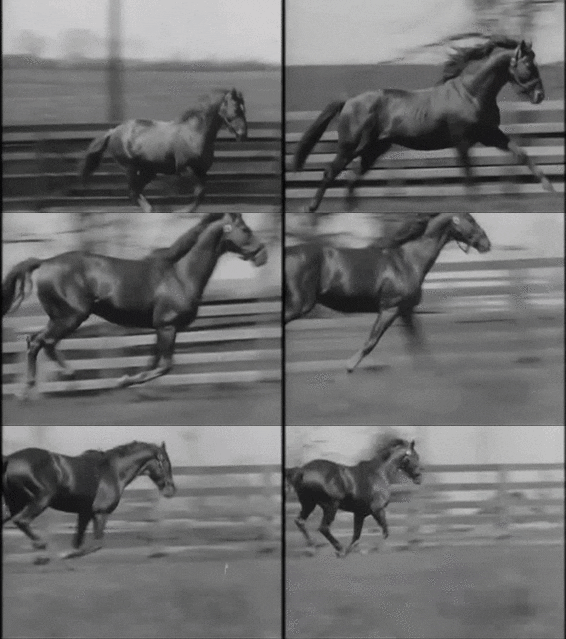

The only worry I have with this kind of work, He is losing energy for coming high from the ground, and than putting four feet almost at the same time down again, meeting a fast track will ruin his joints,as there is to much energy coming back into the feet joints and bones.
To me he would like sofftish ground conditions
To me he would like sofftish ground conditions
-
bcassidy
- Restricted Stakes Winner
- Posts: 876
- Joined: Thu Sep 16, 2004 5:36 pm
- Location: Springfield twshp, NJ
George, I lost track of this thread and I would like to follow up with you on some of the comments you made as you raise some interesting points.
I wasn't aware that there are two types of fast twitch muscle fibers (A and B), can you direct me to a place where I can get more information about these two muscle types, books, articles, etc. Do you know why there would need to be two types? are they complimentary or exculsive? Do most horses have all of one type? or a blend of two or three types of muscle fibers? If the first 60 seconds are anerobic, why does the bleeding that occurs in the lungs play such a huge role in a horse's performance if they are performing anerobically for the first 60 seconds or so, usually you can see the physical changes of bleeding after only 2-3 furlongs (which would normally be between 22 and 37 seconds---depending upon the distance and class of the race). If they are anerobic at this time, why would oxygen depletion be so critical at this point?
Actually, I have always thought just the opposite, that all muscle activity started out aerobically until the oxygen in that muscle becomes depleted at which time the muscle shifts to anerobic acitivity (muscle functions without oxygen---this leads to the build of lactic acid and the corresponding pain and fatique that lasts for several hours or days after an exhausting event). Anerobic activity is usually encountered after a serious amount of stress has been placed upon the muscle---not the reverse. Are you saying that Anerobic muscle activity occurs first and then areobic muscle activity occurs?
You also mention about oxygen uptake, I assume you are saying that if the muscle activity starts out anerobically than the need for oxygen in short races (is almost non existant) because they are in an anerobic phase for the first 67 seconds to 2 minutes and the real need for oxygen would be in races longer than two minutes or the recuperative process after a race. Is that what you are saying?
Again this is totally contrary to what I have always thought (as well as what I have been taught) to be the case. Maybe you can restate your comments so that I might understand them better. I am definitely missing something. Respectfully
I wasn't aware that there are two types of fast twitch muscle fibers (A and B), can you direct me to a place where I can get more information about these two muscle types, books, articles, etc. Do you know why there would need to be two types? are they complimentary or exculsive? Do most horses have all of one type? or a blend of two or three types of muscle fibers? If the first 60 seconds are anerobic, why does the bleeding that occurs in the lungs play such a huge role in a horse's performance if they are performing anerobically for the first 60 seconds or so, usually you can see the physical changes of bleeding after only 2-3 furlongs (which would normally be between 22 and 37 seconds---depending upon the distance and class of the race). If they are anerobic at this time, why would oxygen depletion be so critical at this point?
Actually, I have always thought just the opposite, that all muscle activity started out aerobically until the oxygen in that muscle becomes depleted at which time the muscle shifts to anerobic acitivity (muscle functions without oxygen---this leads to the build of lactic acid and the corresponding pain and fatique that lasts for several hours or days after an exhausting event). Anerobic activity is usually encountered after a serious amount of stress has been placed upon the muscle---not the reverse. Are you saying that Anerobic muscle activity occurs first and then areobic muscle activity occurs?
You also mention about oxygen uptake, I assume you are saying that if the muscle activity starts out anerobically than the need for oxygen in short races (is almost non existant) because they are in an anerobic phase for the first 67 seconds to 2 minutes and the real need for oxygen would be in races longer than two minutes or the recuperative process after a race. Is that what you are saying?
Again this is totally contrary to what I have always thought (as well as what I have been taught) to be the case. Maybe you can restate your comments so that I might understand them better. I am definitely missing something. Respectfully
best regards Brendan