Had a chestnut filly born the other day. The mare is bay and the stallion is bay. Does anyone know if chestnut coloring is dominant or recessive?
Three years ago, the mare had a chestnut filly by a chestnut stallion.
Thanks for your help.
Chestnut Color- Dominant or Recessive
Moderators: Roguelet, hpkingjr, WaveMaster
Charting Chestnuts
Sam wrote:I believe it is recessive, but that it can be carried by a bay horse. So if you have two bays that both carry it, they can have a chestnut foal.
Chestnut based horses - "??ee"
Includes Chestnut, sorrel, palomino, cremello, gold champagne, flaxen sorrel, sorrel/white, etc.
We already know that a chestnut based horse is always going to be "ee" so we have that genotype. What is at the "bay" gene pair is a mystery. You may be able to determine some info from foals and ancestry.
Ancestry -- If the chestnut horse had a black parent than he must carry at least one "a" - if both parents were black based then the horses genotype is "aaee". If both parents are chestnut based it makes it much more difficult. You can go back another generation to find any black or bay based horses to figure out the odds of "a" or "A" - but as soon as the chestnut base is introduced you have no way of knowing "for sure".
For example your horses sire is chestnut, but his sire and dam were both black. You could then determine that the horses sire was aaee and that he would have contributed the "a" to your horse and therefore you have "a?ee".
If one of the parents was bay, the odds of your chestnut carrying "A" is increased, but since a bay can be "Aa" there is no guarantee that the bay passed the "A" to your horse.
Foals -- If you have had foals out of your chestnut horse you may be able to determine genotype that way.
Foaling History:
1) Chestnut had a black when bred to a black or bay - genotype is "a?ee"
2) Chestnut had a bay when bred to a black - genotype is "A?ee"
3) Chestnut had a black when bred to a bay - genotype is "a?ee"
If your horse produces both 1 and 2 or your horse produces 2 and has a black parent you would know its genotype is "Aaee".
Hope this makes sense for you.


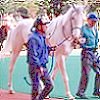
The great SECRETARIAT (1970) is good example of a chestnut coming from non-chestnut immediate parents.
As per two chestnut parents throwing a chestnut foal that occurs theoretically 100% percent of the time. When two chestnut parents don't throw a chestnut foal it is because an error occurred in wrongly registering that foal as a non-chestnut when actually he was one.
The other scenario is when a sabino white foal is born from two chestnut parents like was the case of WAR COLORS, who was foaled 1963. Again, in this case there is no error for that foal looks white outside, but, actually, he is a genuine subjecent chestnut.
where the subjacent non-perceived color
As per two chestnut parents throwing a chestnut foal that occurs theoretically 100% percent of the time. When two chestnut parents don't throw a chestnut foal it is because an error occurred in wrongly registering that foal as a non-chestnut when actually he was one.
The other scenario is when a sabino white foal is born from two chestnut parents like was the case of WAR COLORS, who was foaled 1963. Again, in this case there is no error for that foal looks white outside, but, actually, he is a genuine subjecent chestnut.
where the subjacent non-perceived color
-
rds
- Weanling
- Posts: 37
- Joined: Wed Jan 12, 2005 1:35 pm
- Location: NM but recently and still partially in CA
How about gray
One of these day's I'm going to pick up a book on color genetics, but for now, I'll just ask 
So what is the story when you get a gray foal from 2 bay parents?
So what is the story when you get a gray foal from 2 bay parents?
-
Karie

- Grade III Winner
- Posts: 1143
- Joined: Fri Sep 17, 2004 11:03 am
- Location: Livonia, Michigan
- Contact:
hmmm.. last year I my chestnut mare (with a blaze and 4 socks) had a bay filly from a Grey stallion and this year was bred to a Dk. Bay Quarter horse and had a LIGHT chestnut filly. She is an Appendix Quarter horse and would probably be registered as a Dun.. but the kicker is that the Quarter horse filly has blue eyes! wierd.....
-
rds
- Weanling
- Posts: 37
- Joined: Wed Jan 12, 2005 1:35 pm
- Location: NM but recently and still partially in CA
Maybe gray foal
I think I might... I have a filly who looks like she might be gray. Was a late April foal, so it's still early. Her Dam is by a gray sire, but is a bay herself, and the sire is a bay. The filly is kind of a taupe color and is showing some definite gray tints.
rds, in order for your filly to be grey, she must have a grey parent. If she does turn grey, you should do a paternity test on her.
Karie, the grey stallion that sired the bay filly you had last year must have had a base color of bay. (Grey isn't a color, it's a pattern or an overlay on top of the horse's color.)
Karie, the grey stallion that sired the bay filly you had last year must have had a base color of bay. (Grey isn't a color, it's a pattern or an overlay on top of the horse's color.)
-
louis finochio
- Darley line
- Posts: 9181
- Joined: Wed Sep 22, 2004 5:21 am
- Location: Alhambra-Calif.
- Contact:
louis finochio wrote:Pay attention to the color of the superior runners are the SR bay or ch.?
The colors are the key to the superior runners as they inherit those genes that make them head and shoulders above the other colors.
blink
double blink
jaw falls open .. snaps shut.
head shake
That's like betting on a horse because his sire had 4 socks and so does he.
-
yukidragon
- Starters Handicap
- Posts: 616
- Joined: Sun Oct 31, 2004 11:29 pm
- Location: Oregon

-
louis finochio
- Darley line
- Posts: 9181
- Joined: Wed Sep 22, 2004 5:21 am
- Location: Alhambra-Calif.
- Contact:
I will quote what Tessio said this topic. I finally understood why two TB horses, although born of the same sire and dam, which our full brother and sister may turn out to be one chestnut a great runner and the other a bay a medicore runner.
Even Tessio the master breeder knew of this dominat and recessive color breeding pattern. So pay attention what color the superior runners are and you will be following the pattern Tessio used.
Even Tessio the master breeder knew of this dominat and recessive color breeding pattern. So pay attention what color the superior runners are and you will be following the pattern Tessio used.
Those without sin cast the first stone.
Louis Finochio
Louis Finochio